TRANSCRIPT
[00:00:02] Carers QLD announcement:
Choice and Control is a podcast celebrating meaningful inclusion of people with disability in our communities, brought to you by carers Queensland, your NDIs local area coordination partner in the community. Each episode provides a conversation space for people with disability, their families and carers to share their stories with you. We also hear from members of the wider community, local businesses, and community leaders who share information, ideas and possibilities to give you more opportunity and more choice and control in your life.
Tracy (voice-over)
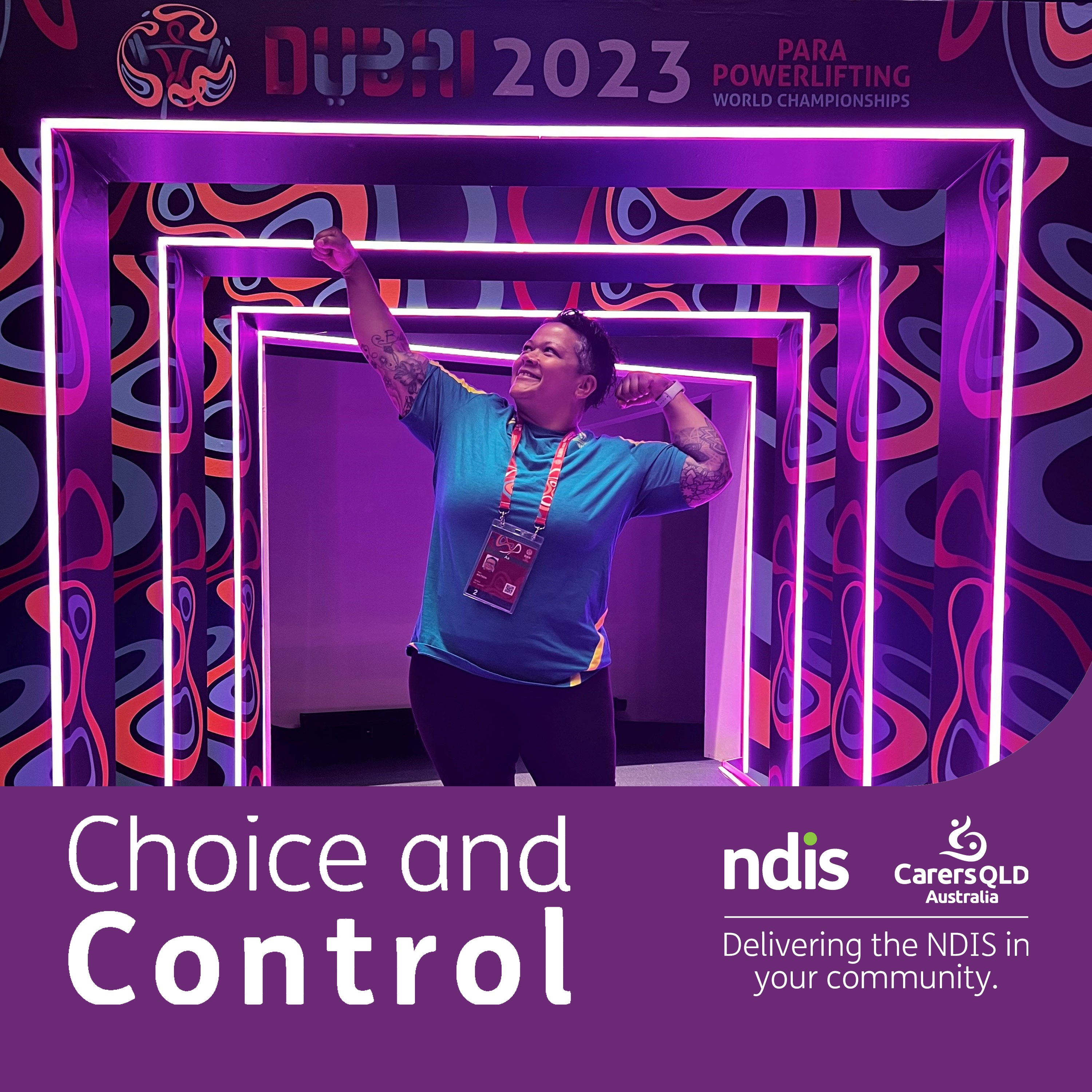
In this episode, we feature 41-year-old Hani Watson from Brisbane, who'll be competing at the Paralympics in Paris as Australia's first female para powerlifter in twelve years. Hani was born with bilateral metaphysical dysplasia which bowed her tibia and femur bones, resulting in numerous surgeries and painful recoveries. She was introduced to powerlifting at an early age, yet becoming a Paralympian never crossed Hani's mind until a few years ago.
In 2021, she was classified for the sport and competed at the World Championships in Georgia, breaking an Oceana record and finishing 8th overall at only her second competition. Hani also broke Australia's 16-year medal drought in the sport when she won bronze in the women's heavyweight at the Commonwealth Games in Birmingham 2022 with a best lift of 127 kg. Our interviewer Emily caught up with Hani before she flew out to Paris and started by asking her how her journey in powerlifting first began.
[00:01:49] Hani (interviewee):
Well, my dad was a bodybuilder, natural bodybuilder. So I've always been around weights and I've always been curious about weights and I'd go and hang out in the gyms with him, the old school, like eighties and nineties bodybuilding where they had like the stringer singlets and the pinstripe tights and all that kind of stuff, those big, big burly men and all that kind of stuff, with the permed hair and all that kind of stuff. So, I've always been around it and I've always been fascinated by it. But I couldn't do much leg stuff with him, so he used to teach me how to do a lot of upper body stuff, like sort of dumbbells with benching and all that kind of stuff. And he said, you know, if you can't do that, then at least you can do the top half. There's no excuses there. So yeah, I would stand there, and I'd pick up his barbell and I'd, you know, wiggle the weights off and they'd fall off the ends and I'm like curling it and all that kind of stuff. So, there's my earlier memories.
When I was about, I say about six, about six years old, I started doing those things with him and just hang out with him and do that. And then. And I've always been in a gym of some sort because it's been an outlet for me, I suppose, throughout life, throughout high school, primary school, that kind of stuff, because that's what I could do. I couldn't go running down a track or something. I'd certainly try, certainly try. Long jump or high jump is obviously not my forte at five foot high. I'd certainly give it a good old crack. But then it got to a point where I just couldn't do all those sorts of things anymore. And then the surgery started trying to fix my legs and all that kind of stuff when I was about nine.
So, I have a birth defect. It was given a title of metaphysical dysplasia, bilateral leg. So, both legs were severely bowed when I was born. Like generally born with bowed legs, but they generally grow straight. Mine just got more bowed as I got older. And so, they're about 45 degrees bowed from the femur to the tibia.
To me, that was normal. I was normal, and my parents treated it as normal. Lucky. Just any regular everyday kid. Yes. You know, it wasn't a disability. It was only until I was a bit later on in life when it became such a huge issue for me that I was like, you know what? You actually have a disability. There's something a little bit different about you and stuff like that. And then it was an orthopaedic surgeon that sort of bowled me up. Even though I had many surgeries beforehand. When I was younger, they actually stopped me from going any taller. They took all my growth plates out when I was younger because I didn't know what was causing the bowing, basically.
So, they… That's why I'm so short. So, I've got size ten and a half feet, which would say I'm probably about, least about a 510, 511. But I'm only five foot one, five foot two, maybe so. And I always thought, you know, if I was ever to do anything, you know, to fix them, to get them straight again, I did that when I was younger, but I got to about 31, and an orthopaedic surgeon sort of just looked at me and he goes, what are you doing about those legs? And I said, nothing. I'm not doing nothing about them. But then he convinced me over about six months to basically break them one by one and straighten them, put like, massive amounts of plates and screws to hold them together.
My left leg, which was my first leg that I got done, was by far the worst journey I've ever experienced in my life. It took about eight months for the bone to actually grow and for me to basically put any weight through the leg. And then once that was okay enough, I think, ten months later after that, it was then jump onto the right leg and then try and see if we can straighten that one. So, it was the same thing. Break the femur, break the tibia, straighten it out. The bones were basically broken in all pieces and put back together again.
And then it was about maybe a year and a half after those both were being done and constant rehabilitation and about a year later, I couldn't walk on my left leg. I lost the ability to walk on it. And it was just like, it felt like I'd broken it in so many places. And I had emergency surgery, and they removed the metalwork out of the leg, and then all of a sudden, I could walk again, which then said to them, my bones were growing back bowed again, and they were pushing the metal out, which is not normally what would happen. So, they eventually removed all the metal out of my legs and they're just going back bowed again. But the end product was obviously all that surgery, and that work failed and now I live with, like, severe chronic pain, and I'm now facing osteonecrosis in my knees. So, after Paris is going to be quite the journey again.
It's hard, isn't it? It's hard. I suppose it's like, it's not anyone's fault. No one actually saw or could, you know, see that my legs were going to do what it did like, it had a genetic disposition to go and do what it wanted to do, and no one could ever predict that. So, I don't hold any grudges against anyone, you know, about that. At the end of the day, I always say to everyone, like, the silver lining was I became so disabled enough that I could become a Paralympian. And that's a sick way of thinking about it. But I… And I live with something that's quite horrible, but I get to do something that inspires a lot of people, and it motivates me to constantly be stronger.
I like the sport that I do. I love it, you know, and I see a lot of younger generations coming through now who have gotten some sort of leg disability or something like that, that they like… Well, if I can do something on the top half of my body, then I'm not completely written off from life and purpose. It gives them something to look forward to, a bit of hope, you know?
So, I'll keep doing it until I can't do it anymore, you know, everything switches off when I'm on the platform, everything switches off. So, when I get ready and I'm at that gate where before they say, bar is loaded, I've got two minutes. And that's where I sort of, everything comes on and everything's blinkered and everything sort of quietens down. I can't hear anything other than myself, my own breathing, and then my coach's voice. And he has been trained by me to tell me what I need to do and all that kind of stuff and tell me what time I'm up to, and I just keep calm. I just listen to my own breath. I have a little mantra that I go through, and I tell myself those things, and I just slow everything down.
And the pain that I experience on the platform when I get stretched down, it's only temporary. It is only going to last for only about 30 seconds. Once I then lift the bar. So long as I've left the bar, the press is only like a couple of seconds and I'm done, you know, and it's only temporary. And my body sort of just takes over. It's like a muscle, sort of like memory, and it just does its own thing, and I just get up there and do it. And it's probably the one time where everything does switch off and it becomes meditative for me, like it's a form of meditation, and it's just a quiet place and it's a quiet place of focus for me. And it's exciting at the same time as well, you know?
[00:09:11] Emily (voice-over):
And what are you lifting? What's weight? What size is it?
[00:09:15] Hani:
My best in competition is 138 at the moment. 138. I can press 145, not comp spec. Like the one thing a lot of people look at. It's like, why do people, so many people fail their lifts on the platform when they watch it, and they watch me compete? It's very specific. It's a very strict sport with its rules. Your elbows have got to lock out at the same time. There can't be significant amounts of body movement. You've got to press the hold the bar on your chest for a mini second, and your bar's got to be like, at a dead stop before you're allowed to press it. You know, you've got command calls by the ref behind you, all sorts of things your butt can't lift, your head can't lift all sorts of things. So as long as you complete all of those, you get a good lift.
You know, I think in Georgia, the first lift I had, I clipped, even though I pressed it, I clipped the rack as I went up, and that's no lift. So, you know.
(Oh, that's tough, that's quite strict. Hey.)
Very, very strict. Yeah.
[00:10:22] Emily:
So, you must have incredible core as well to keep you.
[00:10:28] Hani:
Yeah, yeah. You've got to have core strength, you know, good thoracic sort of stabilization and obviously good upper body strength. And that, you know… and mental toughness, I always say it's all about confidence, being under that bar, like, it's all the weight that you're pressing. It's all relative at the end of the day, but if you don't have the confidence, you'll talk yourself out of it. You won't be able to, so.
Well, I actually did normal powerlifting after all my surgeries were done. I needed someone to help me to fix the gait of my legs, to activate the muscles that I have because they all sit in different positions. So, we did the squat and deadlift and that because we needed that compound movement to press the bones and get the bones to strengthen and to grow. So, I did that for a little while until it just all went pear shape and sort of my bones couldn't do it anymore, but then I still could do bench. I've always done that sport. I've done it for funsies, basically, but it was only like, yeah, like I said, three and a half years ago, I got picked up professionally to do it.
I've always had any sport that I could do, but it all is leg dominant. I was never really introduced to disability sports or anything else I could possibly do, like track and field. I could have done something like that, but I didn't grow up with it, unfortunately. Kind of wish my parents could have seen a little bit, you know, like that. You could have done something like that, but I didn't. But my parents divorced when I was, like, five, so there's one parent, actually, very gym focused, and then there was another parent. She made me do archery when I was, you know, younger. But walking those big fields was a tough thing for me, so I'd have to get her help a lot of the time.
So, I've always done something along the way with my mum or whichever, like that kind of stuff. But again, I always fell back into doing a lot of gym work. And then when I was 15, like, my mum had a bit of a psychological breakdown and then sort of, I couldn't live with her anymore, unfortunately. I don't blame her for that. But then I ended up in a share house. I looked after myself, putting myself through high school. My father wasn't around either at that point in time in my life and in that era of that, that timeframe, like child safety wasn't a thing that strong for me. I just sort of just do what I could do to manage. I didn't have much family support at that point.
And then the only thing I had was that my high school gave me the key to the gym and said, you were welcome to go to the gym. And I would do that. I'd catch the train, and I'd go to the gym at 06:00 in the morning and train for a couple of hours. And then I'd go to school and then I'd work it on home. It kept me focused.
That was the principal? Yeah. Mr. Brennan. He passed away probably about four years ago. And I owed a lot to him because he, he knew I had a bit of a tough upbringing and… But he knew that if I had something to have and to do and that kind of stuff would obviously keep me on a, a good path, basically. So, I have a lot to thank for him in regard to that too.
[00:13:39] Emily (interviewer):
Wow, man, you're an extraordinary, you've had an extraordinary life. And it's still just starting really, isn't it? The second half of your… It's just another chapter that opens up, isn't it? So, before you. So, three years ago, you had three, four years ago. No ambition at all to be a Paralympian?
[00:13:50] Hani:
No, I mean, like everyone wants to be an Olympian. Olympian, you know what I mean? We all grew up watching Commonwealth Games and the Olympics and the Paralympics, and I've always watched all of them and I had an appreciation for all of them. Like Louise Savage on the wheelchair racing, all that kind of stuff. But I only got introduced to wheelchairs like two years ago, and I'm still fighting mentally about being in a wheelchair and then sort of giving up that part of my independence to having to be in one more regularly because I can walk around. That's another thing I have to face, is that some people see me walk and some people don't.
You know, it's… But I have to be in my chair more frequently. But I've always grown up around it and understood it and that kind of stuff and had appreciation for it. But I never thought ever, if you asked me five years ago, would you see yourself at a Paralympics or Commonwealth Games, I would have just giggled at you. And I'm like, whatever (laughs).
[00:14:55] Carers QLD announcement:
LAC Connect. It's a new way to stay in touch with your local area coordinator at Carers Queensland with everything you need right here on your device. It's a handy app to keep track of your LAC appointments, browse workshops and events, check out information and support, and get the latest news, stories and podcasts. It's available on Android and iOS, so whatever device you have, you can stay in touch. Head to our website to sign up @carersqld.com.au and look for LAC Connect.
[00:15:28] Tracy (voice-over):
In addition to being an Australian Paralympian, Hani Watson has been a full-time healthcare worker for many years and uses her natural empathy and personal experiences to help patients in hospital.
[00:15:42] Hani:
Yeah, full time working. I've always worked in healthcare, so administrator and AO, always enjoyed working in hospitals and stuff, usually private hospitals and as a team leader, manager, that kind of stuff, and just greeting patients as they come in, whether it's booking them in, in or discharging them out. And then their journey is a really good journey. So, I always know that when a patient comes in, they're scared, they're anxious, your energy needs to be a little bit different. It needs to be that you're a little bit sort of more heightened, aware of being a little bit more positive, because then your outcome is going to be a little bit more different rather than negative. And then your negative energy is going to impact how you recover and all that kind of stuff.
So, I've always been very passionate about what I do to change a person's mind frame about why they're in hospital or why they're sick, that kind of stuff. I know what it's like to sort of struggle every day. And I could sit here, and I could wallow in the pain that I experience and the difficulties I face, but then what's that going to achieve? At the end of the day, it doesn't achieve anything. It doesn't, you know, it's not anything positive. And I just sort of sit there and like, I can give so much more to myself, let alone, I'm not a person to my friends, my family, that kind of stuff. I've always had that attitude.
So, I now work in like an emergency department. We get a lot of patients coming in on, you know, the ambo trolleys, that kind of stuff. And you can see they're frightened, they're sad or they could be crying or whatever, that kind of stuff. And I'm the clown that comes along and, you know, asks, yeah, how are you? You doing all right today? And they sit there, go, oh, yeah, yeah, I'm okay. I say, what's up, are you lying to me? You're here in emergency. What's going on there? I'll be typing away, you know, and, you know, I just catch them out and I'm like, oh, yeah, yeah, that, yeah. You know what I mean?
Like, it's just changing the narrative of why they're there and it's not, it's not all just a sterile environment. It's meant to be sort of like, we're here to help you and that's what we're going to do from all different levels, you know, from the physical to the mental, that kind of stuff. You know, you want it to be a nice journey. You know, when I started this journey, I was working full time, but then obviously my disability in the last three years has sort of just continued on a sliding scale with my legs and that's not anything that I've done, but it's just my knees are just starting to say no, thank you.
And I'm doing everything that I can to sort of like, you know, be conservative because I've just, I'm over surgeries, to be perfectly honest. It's not the answer. At the end of the day on some people, if, if you ask me, I'd like to just chop these legs off and just be done with it and then just move on and just adapt to that lifestyle. But, you know, it's in time, we'll get to what I need to do and that kind of stuff. But I used to work full time. I used to be in a sitting position most of the time, but now I can't do the adjustment of sitting, standing, walking and that kind of stuff. It's just, you know, after adjusting wherever I go and now I'm working in ED where it allows me to be in my wheelchair.
So, I've been very much supported and when my mum passed away last year, she said, you know, like, you're going make some pretty big sacrifices. And the one of them was to, you know, really pull back on working and work to what you need and that's obviously keep a roof over your head, pay your bills and put food in your stomach.
And then Q.A.S. which is Queensland Academy of Sports, came along and they picked me up and I'm sort of like a supported Queensland athlete and I'm given, you know, some sort of help there to buy equipment that I might need at home. I go and train there they give me someone to help me bend my legs and carry things for me or set things up for me.
And then when I came back from the Commonwealth Games, then with a medal that gave funding to the bigger program, which then my coach will come up every couple of weeks now as we lead into Paris and he'll come and, you know, spend some time with me, that kind of stuff, and we'll train in good conditions. Like, there are some athletes out there that do get a lot better funding. That's a lot of the Olympians, the top medal ones, you know, the top contenders that are constantly bringing home the bacon. So, to say they're going to be supported and given a lot more grants than anybody else. And I always say to my teammates now, like, the more medals you bring home from all of the other events, not just the big ones, but all the other ones, you know, it's going to say the program's working.
You're all actually, you know, you're putting in the hard yards. They're going to want to support you so that you do bring home more medals for Australia, that you do have that representation, that kind of stuff. So, you've got to work hard to get that support. And I have certainly worked as hard as I have to be sent over. So, I have been lucky to be sent over and not have to sort of really pay for a lot of that myself that's come out of that funding than what I bought back from Commonwealth games, which I'm very grateful for. But everything else, like, I don't work, I don't get annual leave or that kind of stuff. So, I have to budget it. I have to work and push myself pretty hard to make sure I've got money that supports me. So, when I'm gone for three weeks in Paris, I've got that money there to pay for my rent and my bills and all that kind of stuff. So, I've got to be very good with budgeting.
When I started this sport, I never thought, you know, I'd go to another country and be a victim of crime, be traumatized as much as I was to protect somebody else. I was assaulted. I never thought I'd return back to the sport, but I thought, you know, I don't want that to be taken away from me. And then getting through that, that trauma and having to face it all the time, every time I go away for a competition is, it's really hard mentally, let alone the physical side of things I've got to do as well.
And then having my mum pass away from metastatic breast cancer. And then she was on the assisted dying program for Queensland when it was just introduced. Literally just got introduced. She was put on it and I was her support person.
And having to put her through that and be that person for her and still try and push through with my sport, that was hard, I think, you know, like, the last things that she said to me was like, ‘don't give up, you know, if you finally found what you're good at’.
We are resilient as a human race. We can, like, it's just whether or not you want to and you want it bad enough, I suppose. But it is possible, no matter what you face through in life, you can do it. And any opportunity will present itself what it needs to, to, you know, and mine itself. When I was 39 at the time, you know, and then here we are, three years later, we're now at the Paralympics, you know, and that's like the biggest, like, sporting event you could possibly think of that anyone would want to get to. It takes most people on average, like, it's taken many three cycles to try and get to a Paralympics to try and qualify, but this is my first cycle, so I'm pretty proud of that.
So, I sit to sit here and reflect upon, despite everything that I've been through just the last three years, you know, I've got there, I set myself a goal and I got there. And the driving force behind that, a lot of it was, was that my mom said not to give up. And, you know, and my coach was just like, I see so much in you. You haven't hit your peak in that, you know, and then he, as a coach, the pinnacle of any career of a coach was to try and get anyone to a big event. So that was a big driving force for me, too. Let's not let him down and everyone else that supports me, I don't want to let you guys down. I just want to get there so that you can say, like, yeah, I've been on that journey with her, you know, so I didn't want to let anyone down, let alone myself. So, I'm really proud. I'm really proud of what we've all achieved together.
[00:23:48] Carers Qld announcement:
Disaster doesn't discriminate in an emergency. Our community and first responders need to be ready to help keep everyone safe. Cares Queensland is working with local agencies and emergency services to ensure people with disabilities are considered and included. Everyone has a role to play at times of disaster by people with disability, creating their own person-centred emergency preparedness, or PSAP plan and sharing their plan with their support network, they can feel more confident to keep safe during emergencies. Find out more, get in touch, or look for events and opportunities coming up near you. Visit our website, carersqld.com.au or call our inquiries line on 1300999636.
[00:24:31] Hani:
Most of the time when we get to go to overseas, some other competitions and stuff, we don't get to go and play a lot or go and do anything because we're training, we're eating, we're resting, we're training, we're eating, we're resting. We might get one day to play, but I'm excited that we might be able to have a little bit of a look because we're actually staying out of the village. My coach and I, we're going north of Paris along a beach area, and so I get to go get be close to where I feel very comforted is near water. You know, living on the bay at Brisbane and then my friends living on the Gold Coast, I could get to be near water and that kind of stuff that just makes me spiritually very much connected and sort of calm and stuff. So, I'm glad that we get to do that in Paris.
Oh, you never know what's going to happen. You never know what happened. But they. I just, you know, sometimes you're going to sit there and realistically look at it and go, you know, as much as I would love to be on that podium, it might happen. You never know. Anything can happen. I'm just going to make sure I'm there to beat my last score. Like it's always me against me. I'm always wanting to better myself. Like this year, if I look at it from a big picture, I've already done three competitions this year. One on the Gold Coast, then over in Egypt and then Georgia. And each time I've competed, I've put more weight on the bar. I've actually had a better pb every time I've got along, and I've broken my own record four times already this year. So that in itself is a big achievement for me. And if I can do continue to keep doing that at Paris, you know, I'm happy. I'm very happy to keep beating myself. That says that my progression is still going up. I definitely want to probably try and hit around 145. That's where I'm hoping I'll end up. But, yeah, we'll see how we go.
[00:26:19] Tracy (voice-over):
After working hard and demonstrating enormous dedication and aptitude for the sport of powerlifting, Hani now represents Australia on the world stage and has this advice for aspiring para-athletes.
[00:26:33] Hani:
Just don't give up on the dream. Like we all, at a young age, we watch the Olympics. Like when we're 10 or 15, around that sort of age, we watch the Olympics, we watch the Paralympics, and you watch people come out on that opening ceremony. When you watch that, it rather, what you feel at that point in time is exactly what it feels like when you're actually at the opening ceremony. The energy and the excitement and the emotion, it's so incredible. And it's something that definitely is, definitely worth working towards. It's a once in a lifetime opportunity and we only have one life. So, if you've got a superpower, it's going to take a long time sometimes for some people to find their superpower, sometimes it's going to be a short time. Never give up on it.
It could be like crocheting, like the world's longest blanket. It could be anything from like the big building, the biggest Lego tower house, whatever it is, find out what that superpower is going to be. Never let up. Never give up on yourself. It's going to be hard. And anything that's worth, you know, working towards that you love and you're passionate about, it's worth it. At the end of the day, just keep going at it and you're just going to continue to keep reflecting on how proud you're going to be, the journey that you take on your own merits. So, like that, that's, you know, I'm 41, I've managed to get there for years. You know, any opportunity is going to present itself at any time, so always keep chasing it. Chase a goal. Chase all the goals.
[00:27:59] Tracy (voice-over):
And that was 41-year-old Hani Watson from Brisbane, who will compete in para-powerlifting in this year's Paralympics in Paris. If you'd like to follow Hani's journey, visit the links in the episode transcript. And for more stories from our Queensland Paralympians, tune in to Choice and Control for more powerful podcasts.
Carers QLD announcement
Thanks for joining us at Choice and Control, a Carers Queensland podcast. If you've enjoyed this podcast episode, please take a moment to leave a rating and review and share it with your community. For more information about the National Disability Insurance Scheme or Carers Queensland, contact us online at www.carersqld.com.au or call us on 1300 999636 or head to Facebook and look for Carers Queensland NDIS.
Email
[email protected], or sign up to our LAC Connect app here.
LINKS
• Paralympics 2024 Archives - Carers Queensland (carersqld.com.au)
• Lifting barriers: the journey of a Paralympic powerlifter - Carers Queensland (carersqld.com.au)
• Hani Watson | Paralympics Australia
• Hani Watson (@benchqueen) • Instagram photos and videos
• Hani Watson | Facebook
• Meet Australia’s ‘Superwoman’ Of Para-Powerlifting | Paralympics Australia
Interview by Emily Smith
Podcast producer, Tracy Burton